
“What is the history of Morris I hear you ask?” A difficult question to answer, and if you ask six different Morris men you will probably get six different answers. There have been many books and papers written by authors far more knowledgeable than us on this subject, and a good place to get expert opinion is the website of The Morris Ring (more of The Ring later). We make no attempt at a definitive answer, just a flavour to whet the appetite of the inquisitive.
When Did It Start?
What we do know is that the earliest known reference to Morris in England is a tapestry in Suffolk dated 1448, in the reign of Henry VI. There was also a courtly dance called “Morisco”, imported from Spain and named after a minority group of Arabs based in Grenada. A corruption of Morisco may have led to the term Moorish or Morris dancing. Early illustrations show a sort of circle dance.

In Elizabethan times Morris was a regular feature of London parades and Shakespeare’s clown, Will Kemp, is famous for his “Nine Daies Wonder” in which he danced from London to Norwich. Perhaps the first example of a sponsored marathon!

A picture from around 1620 now in the Fitzwilliam Museum, Cambridge University shows Morris Dancers beside The Thames at Richmond. In the picture can be seen the same characters as you will find today – dancers sporting bell pads and knee britches, a musician playing a pipe and tabor, a hobby horse, and a lone figure extracting donations of cash from an appreciative audience! The only thing we don’t know is what the dancing looked like…

Church records from the 16th and early 17th century show the purchase of bells and coats for “ye Morris dancers” and Morris dancing was a regular feature of church festivities. Sadly the Puritan movement of the later 17th century put an end to such frivolity.
After the restoration festivals were re-established, especially around Whitsun. At least one entrepreneur saw this as an opportunity to rent out troupes of “Morris” dancers and the idea caught on. It is perhaps during this period, with little else to go on, that the style of dancing in opposing lines, like the popular dances you’ll see in Jane Austen adaptations, developed.
By the early 19th century it had become a “craze” and almost every village in the Cotswolds had it’s own side of Morris dancers. This was how different styles of dancing evolved in each village so that a dance of the same name could look quite different depending on where it was danced. You’ll hear us call out the name of the village from which our dances come so see if you can spot the differences! It is a version of these types of dancing, now called “Cotswold Morris” that Yateley dance today.
There are other Morris related traditions around the country: “Border” dancing from the Welsh marches, “Molly” dancing in East Anglia, sword traditions from the north east and processional clog from the mill towns of Lancashire and Cheshire. This last one blossomed in the early industrial revolution but everywhere the changes in popular music and dance began to cause the decline of most folk traditions. Perhaps it was the large prosperous estates of the Cotswolds that allowed a highly developed form of Morris to survive rural depopulation in at least some important fragments.
The Folk Revival
Towards the end of the nineteenth century so much had been lost of the Morris tradition that a few collectors were inspired to save what they could before it was too late. Amongst these collectors, Percy Manning and Thomas Carter from Oxford, persuaded some members of the old Headington dancers to start dancing again. The result was a public performance of the Morris on the 15th March 1899 at the Oxford Corn Exchange. All of this revived the dancers enthusiasm, especially since they could earn some money via their dancing. So it was that Cecil Sharp, an avid folk song collector, was taken to see the Headington Quarry side dancing on Boxing Day in 1899. This was a momentous occasion, both in changing the course of Sharp’s life, and for English folk dance and especially the Morris. You can find more about Cecil Sharp here.
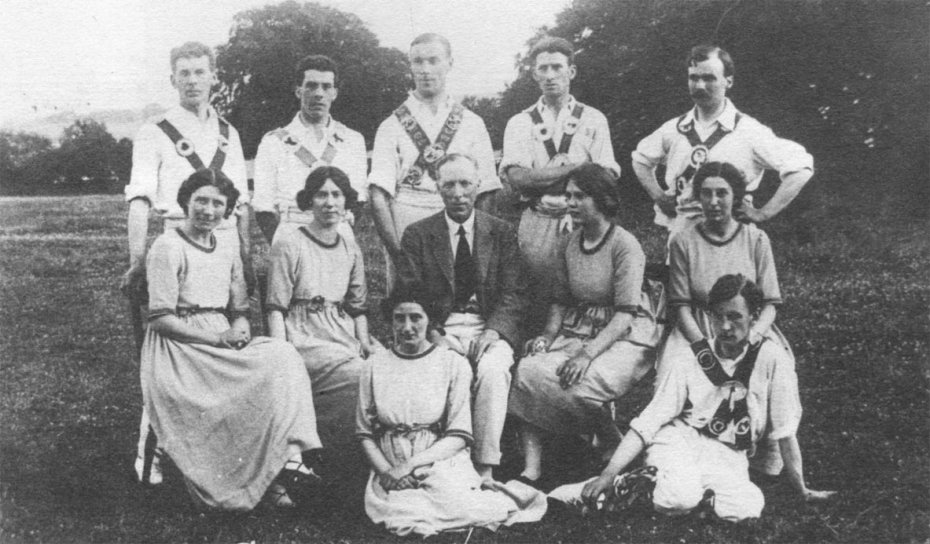
In the closing years of the nineteenth century, one woman, the suffragette Mary Neal, helped generate a huge revival in folk dancing and singing when she sought out songs and dances for working girls in a deprived area of London. In 1905 she contacted Cecil Sharp for songs and Morris dances that her girls could use. At first she worked closely with Cecil Sharp, but the two were soon to fall out. He, wanting to keep to the rigid tradition of the dance as he saw it and she having a far looser approach. Indeed, there is a thought that without the input of women after The Great War (1914-18) that once again the Morris could have disappeared through lack of participants.
Lucy Neal, her Great-Great-Niece and the co-founder of the London International Festival of Theatre, has decided that Mary’s papers should be kept in Cecil Sharp House. She explains why in this article about Mary Neal published in the Guardian on February 7, 2009.
Initially the first half of the 20th century saw revival teams come out of the universities. Other sides started to spring up in towns around the country and in 1934 the Morris Ring was formed to foster the movement. This is no longer a male only Morris association and has grown over the years to hundreds of Morris sides and thousands of individual dancers all over The British Isles and anywhere worldwide British ex-pats have settled. There is also an organisation called The Morris Federation. They were originally formed to cater for mixed or women only sides.
Another folk revival in the 1970s lead to an explosion of Morris dancing all over the country. Yateley Morris Men, and many of our neighbouring sides, sprang out of this new enthusiasm. Some of our dancers date back to these heady days while newer (and often younger) members have discovered the fun of Morris by watching us dance or seeing it elsewhere. We are pleased that the tradition survives and we hope to keep it going for a long time yet.
To anyone seeking further information good starting points are the websites of the Morris Ring or Morris Federation.
 YATELEY MORRIS MEN